

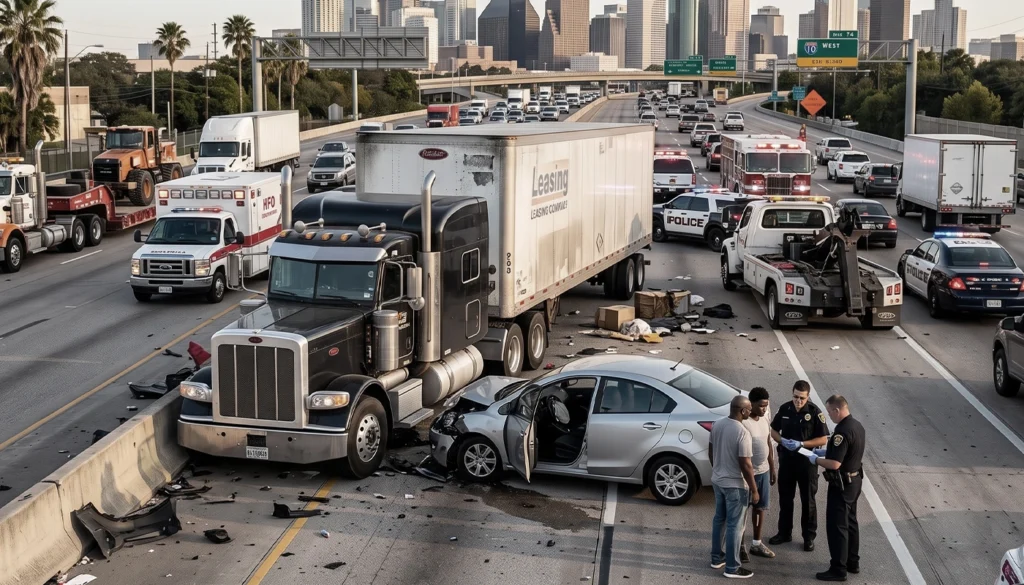
Third-party liability means a person or company other than the truck driver or trucking company may be legally responsible for injuries and losses caused by a commercial truck crash. In Houston, potential third parties can include cargo loaders, maintenance providers, vehicle or parts manufacturers, contractors, vehicle owners, or other motorists. Determining third party liability requires examining the facts, evidence, and applicable Texas or federal rules rather than assuming the truck driver is solely responsible.
If you were injured in a Houston truck accident, a Houston truck accident lawyer can help investigate who may have contributed to the crash and whether additional insurance coverage or responsible parties should be considered. The answer may depend on how the collision occurred, who controlled the truck or cargo, whether maintenance was performed properly, and whether a defective component or another driver’s conduct contributed to the injuries.
Understanding Third-Party Liability in a Truck Accident
Third-party liability occurs when someone other than the immediately involved truck driver or trucking company may have contributed to an accident or the resulting harm. The third party must generally have a legally recognized basis for responsibility, such as negligence, a defective product, or another violation of an applicable legal duty.
For example, a poorly secured load could shift and cause a collision. A maintenance provider’s negligent work could contribute to brake or steering problems. A defective truck component could raise product-liability issues. Another motorist could also contribute to a crash involving a commercial truck.
Who May Be Liable Besides the Truck Driver?
Potentially responsible parties can include:
Cargo loaders or shippers
If cargo was improperly loaded or secured and that condition contributed to the collision, the facts surrounding loading and securement may require investigation. FMCSA cargo-securement rules address requirements intended to prevent cargo from shifting or falling from commercial motor vehicles.
Maintenance and repair companies
A carrier may use outside businesses to inspect, repair, or maintain trucks. If negligent maintenance or repair contributed to a crash, the maintenance provider may need to be investigated. FMCSA materials explain that motor carriers must systematically inspect, repair, and maintain commercial motor vehicles under their control.
Manufacturers and parts suppliers
A defective tire, brake component, steering part, or other product may potentially create a product-liability claim. These cases can involve different legal standards and require evidence connecting the alleged defect to the accident and resulting injuries.
Vehicle owners or leasing companies
The owner of a truck or trailer may differ from the company operating it. Ownership, leasing, maintenance responsibilities, and contractual relationships can therefore become important when determining responsibility.
Other motorists
A passenger vehicle may contribute to a truck crash through speeding, unsafe lane changes, distracted driving, failure to yield, or another negligent act. Multiple parties can potentially share responsibility for the same incident.
How Is Fault Determined When Multiple Parties Are Involved?
Texas uses a proportionate-responsibility system for many claims involving multiple potentially responsible people. Under Texas Civil Practice and Remedies Code Chapter 33, the fact finder determines percentages of responsibility for the claimant, defendants, settling persons, and qualifying responsible third parties.
This means a truck accident does not necessarily have to be an all-or-nothing question of fault. Evidence may show that several people contributed to the harm. Texas Civil Practice and Remedies Code §33.001 also provides that a claimant whose percentage of responsibility is greater than 50% may not recover damages under the statute, while a claimant at 50% or less may have recovery reduced according to the applicable percentage. The exact application depends on the claims and facts.
For a Houston truck accident, determining these percentages can require a detailed investigation rather than relying only on the initial police report.
What Evidence Can Reveal Third-Party Liability?
Evidence is often critical because the party responsible for a truck’s operation may not be the only person or company with relevant information.
Important evidence may include:
- Crash reports: Texas crash reports can provide information about the collision, involved vehicles, and investigating officer’s observations. TxDOT is the custodian of Texas crash records, and qualifying individuals can request certain reports.
- Photographs and video: Images of the truck, trailer, cargo, roadway, vehicle damage, and injuries may help establish what happened.
- Maintenance records: Inspection, repair, and service documents may reveal whether mechanical problems existed before the crash.
- Cargo records: Bills of lading, loading information, securement documentation, and related records may help determine who handled the cargo.
- Electronic and vehicle data: Available electronic records may help establish vehicle operation, braking, speed, or other circumstances, depending on the equipment and information available.
- Witness information: Statements from motorists, passengers, workers, or other witnesses may help establish how the collision occurred.
- Employment and contractual records: Agreements between carriers, contractors, owners, maintenance companies, and other businesses may help identify who had particular responsibilities.
When Should You Speak With a Truck Accident Attorney?
You may want to seek legal guidance when the accident involves serious injuries, disputed fault, multiple vehicles, uncertain insurance coverage, a commercial carrier, or questions about cargo, maintenance, or defective equipment. These circumstances can make it harder to determine who is liable in a truck accident without a broader investigation.
A truck accident attorney near me may also help identify potential sources of evidence and explain how Texas law could apply to your circumstances. This does not mean every accident requires a lawsuit or that a third party is automatically liable. It means the potential sources of responsibility should be evaluated before a claim is resolved.
What Should You Do After a Houston Truck Accident?
If you are injured in a Houston-area truck collision, practical steps can help protect important information:
- Seek medical attention. Get appropriate treatment and follow medical instructions. Some injuries may not be immediately apparent.
- Report the crash when required. Texas law establishes reporting requirements for certain crashes. Follow instructions from responding law enforcement.
- Document the scene if possible. Photograph vehicle damage, roadway conditions, traffic controls, visible cargo, and other relevant details when it is safe to do so.
- Preserve identifying information. Keep the truck’s company name, license information, trailer information, insurance details, and other available identifying information.
- Save communications. Keep correspondence with insurers, trucking companies, employers, and other parties.
- Keep medical and financial records. Records can help document treatment, expenses, lost income, and other claimed losses.
- Avoid guessing about faults. Give factual information, but do not speculate about what caused the crash when you do not know.
- Be careful with settlement documents. Do not sign a release or settlement agreement without understanding what rights you may be giving up.
How Does Federal Law Affect Third-Party Liability?
Texas law generally governs state personal injury claims, but federal motor-carrier regulations may also be relevant to commercial trucking operations. FMCSA regulations are found in Title 49 of the Code of Federal Regulations, Parts 300–399.
Federal requirements can become particularly relevant when the truck operates in interstate commerce. For example, federal rules address areas such as driver qualifications, vehicle maintenance, inspections, and cargo securement. Whether a particular federal regulation applies depends on the vehicle, operation, cargo, and circumstances involved. Federal regulations do not automatically establish liability for every accident. A claimant generally still needs to establish the legal elements applicable to the particular claim and connect the alleged conduct or defect to the injuries and damages.
What Damages May Be Available in a Truck Accident Claim?
Depending on the circumstances, an injured person may seek compensation for legally recoverable losses such as medical expenses, lost income, property damage, and physical or emotional harm. The available damages depend on the nature of the claim, the evidence, and Texas law.
When multiple parties are involved, identifying each potentially responsible party can be important because different parties may have different insurance policies, contractual relationships, or available assets. However, the existence of another potentially responsible party does not guarantee additional compensation. If you are searching for a personal injury lawyer Houston residents can consult after a commercial truck collision, focus on finding counsel who can evaluate the specific facts, potential defendants, available insurance, and applicable Texas and federal requirements.
How Long Do You Have to Bring a Texas Personal Injury Claim?
Texas Civil Practice and Remedies Code §16.003 generally provides a two-year limitations period for personal-injury lawsuits, subject to statutory exceptions. The statute measures the period from when the cause of action accrues.
This is a general rule, not a substitute for case-specific legal analysis. Different claims or circumstances can involve different limitations rules, and waiting until the deadline is approaching can create unnecessary risk. If your truck accident occurred in Houston, timely legal review can help identify the deadlines and claims potentially applicable to your situation.
Read Related: How long after an accident can you file a claim
Injured in a Houston Truck Accident? Act Now
Third-party liability can make a Houston truck accident claim more complex, especially when cargo loaders, maintenance companies, manufacturers, vehicle owners, or other motorists may share responsibility. Do not wait to investigate your legal options. Important evidence can become harder to obtain, and Texas deadlines may affect your ability to pursue a claim. If you or a loved one was injured, Juan L. Guerra, Jr. & Associates, PLLC can help you understand your potential claims, identify parties who may be responsible, and determine what steps to take next.